Car Inspection Checklist
A comprehensive car inspection checklist covering safety, fluids, tires, and mechanical systems to ensure roadworthiness and prevent costly repairs.
Checklist Screenshot
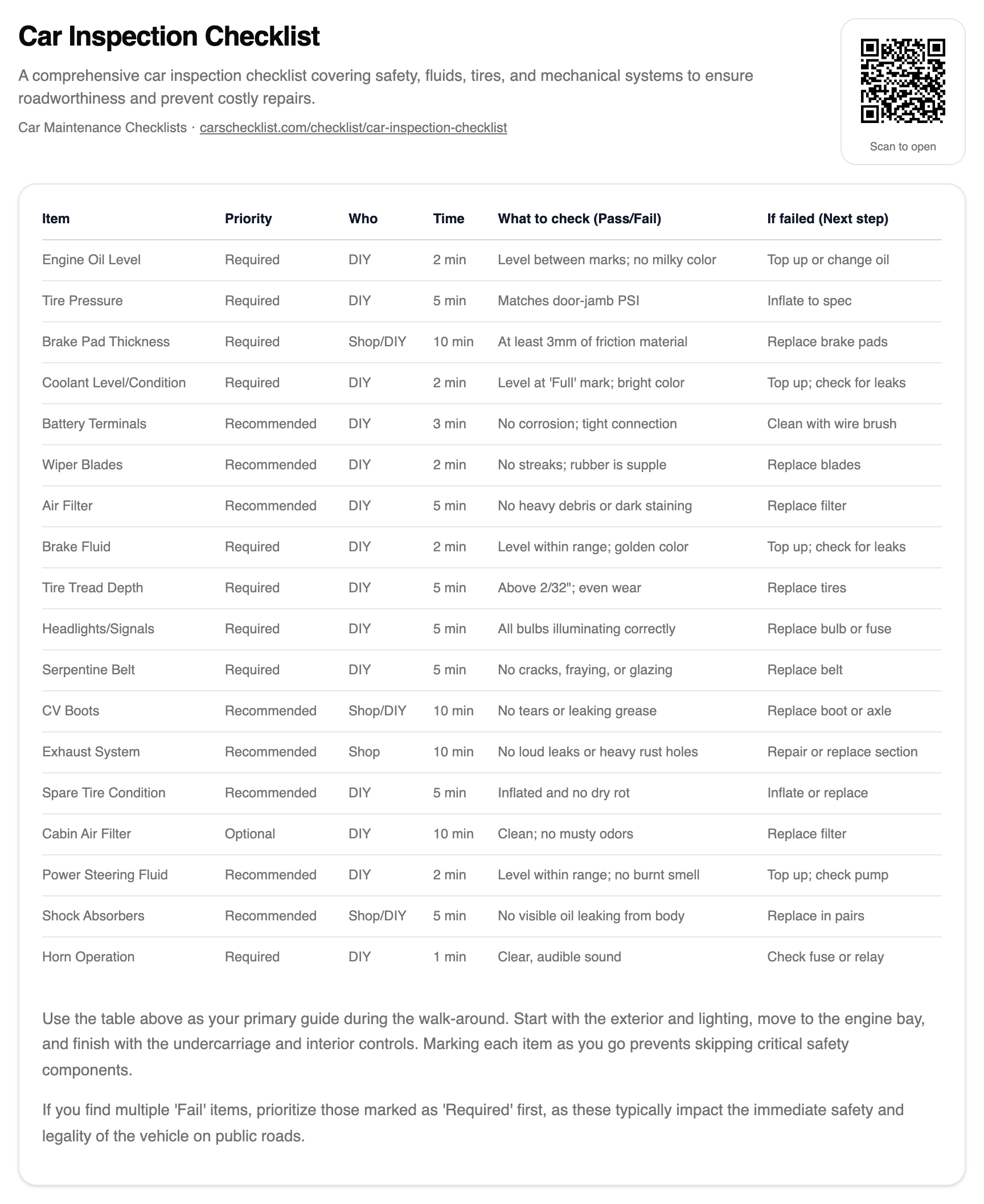
Reference screenshot for this checklist.
Overview
Summary and key details for this checklist.
A thorough car inspection typically takes between 45 and 90 minutes depending on your experience level and the tools available. For a DIYer, this is a visual and tactile process aimed at identifying wear and tear. Professional shops may use diagnostic scanners and lifts to speed up the process, but the core checkpoints remain the same.
Regular inspections are the backbone of vehicle longevity. By catching a torn CV boot or a low coolant level early, you can save thousands in secondary damage. This guide focuses on actionable steps that require minimal specialized equipment.
Printable Checklist
A clean, scannable checklist view. (You can export/print from the sidebar.)
| Item | Priority | Who | Time | What to check (Pass/Fail) | If failed (Next step) |
|---|---|---|---|---|---|
| Engine Oil Level | Required | DIY | 2 min | Level between marks; no milky color | Top up or change oil |
| Tire Pressure | Required | DIY | 5 min | Matches door-jamb PSI | Inflate to spec |
| Brake Pad Thickness | Required | Shop/DIY | 10 min | At least 3mm of friction material | Replace brake pads |
| Coolant Level/Condition | Required | DIY | 2 min | Level at 'Full' mark; bright color | Top up; check for leaks |
| Battery Terminals | Recommended | DIY | 3 min | No corrosion; tight connection | Clean with wire brush |
| Wiper Blades | Recommended | DIY | 2 min | No streaks; rubber is supple | Replace blades |
| Air Filter | Recommended | DIY | 5 min | No heavy debris or dark staining | Replace filter |
| Brake Fluid | Required | DIY | 2 min | Level within range; golden color | Top up; check for leaks |
| Tire Tread Depth | Required | DIY | 5 min | Above 2/32"; even wear | Replace tires |
| Headlights/Signals | Required | DIY | 5 min | All bulbs illuminating correctly | Replace bulb or fuse |
| Serpentine Belt | Required | DIY | 5 min | No cracks, fraying, or glazing | Replace belt |
| CV Boots | Recommended | Shop/DIY | 10 min | No tears or leaking grease | Replace boot or axle |
| Exhaust System | Recommended | Shop | 10 min | No loud leaks or heavy rust holes | Repair or replace section |
| Spare Tire Condition | Recommended | DIY | 5 min | Inflated and no dry rot | Inflate or replace |
| Cabin Air Filter | Optional | DIY | 10 min | Clean; no musty odors | Replace filter |
| Power Steering Fluid | Recommended | DIY | 2 min | Level within range; no burnt smell | Top up; check pump |
| Shock Absorbers | Recommended | Shop/DIY | 5 min | No visible oil leaking from body | Replace in pairs |
| Horn Operation | Required | DIY | 1 min | Clear, audible sound | Check fuse or relay |
Use the table above as your primary guide during the walk-around. Start with the exterior and lighting, move to the engine bay, and finish with the undercarriage and interior controls. Marking each item as you go prevents skipping critical safety components.
If you find multiple 'Fail' items, prioritize those marked as 'Required' first, as these typically impact the immediate safety and legality of the vehicle on public roads.
Notes
Extra context, cautions, and helpful tips.
Once the inspection is complete, document your findings to track the vehicle's health over time. This history is invaluable for resale value and troubleshooting future issues.
- Keep a dedicated folder for service receipts and inspection logs.
- Dispose of used oil, coolant, and batteries at authorized recycling centers.
- Reset maintenance light only after the work is actually performed.
- Note any 'borderline' items to check again in 30 days.
- Check for active manufacturer recalls using your VIN.
- Clean the engine bay carefully to make future leaks easier to spot.
- Verify that all tools are removed from the engine bay before starting.
- Double-check that the oil cap and dipstick are fully seated.
- Browse our fluids guide for more detail.
- See the 3-month checklist for shorter intervals.
Related Checklists
More checklists with similar tags (mileage, interval, season, tasks).
FAQ
Common questions about this checklist.
Start from the complete car maintenance checklist, then narrow down by mileage, interval, and season.